


How Hiring Will Change in the Next 5 Years: The Future of Talent in Global Capability Centers
- BizNews Woldwide
- Jun 8
- 6 min read

The way organizations hire talent is undergoing one of the most significant transformations in modern business history. Advances in technology, shifting workforce expectations, demographic changes, globalization, and the rise of artificial intelligence are redefining how companies attract, evaluate, and retain employees.
Over the next five years, hiring will look dramatically different from the traditional recruitment models that businesses have relied on for decades. Organizations will no longer compete solely within local labor markets. Instead, they will operate within a global talent ecosystem where skills, adaptability, and workforce flexibility become more important than geography.
For businesses investing in Global Capability Centers (GCCs), Offshoring Solutions, Remote Work, and Remote Staffing, these changes represent both challenges and opportunities. Companies that adapt early will gain access to broader talent pools, accelerate growth, and improve operational efficiency. Those that fail to evolve may struggle to secure the talent needed to remain competitive.
As hiring continues to evolve, understanding the trends shaping the future of work will be critical for organizational success.
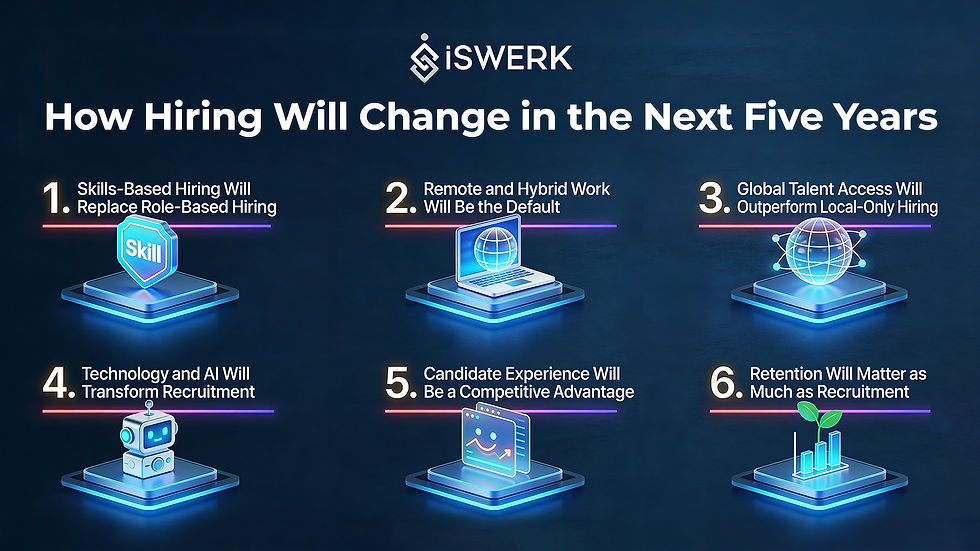
The End of Geography-Based Hiring
For decades, hiring was largely restricted by location. Organizations recruited candidates within commuting distance of their offices or within specific geographic regions.
This model is rapidly disappearing.
Remote work has demonstrated that highly productive teams can operate effectively across cities, countries, and continents. As a result, companies are increasingly prioritizing skills and capabilities over physical proximity.
Over the next five years, businesses will continue expanding their talent searches globally. Rather than asking, “Who lives nearby?” organizations will ask, “Who is the best person for the role regardless of location?”
This shift will significantly benefit Global Capability Centers and offshoring initiatives.
By accessing international talent pools, organizations can fill critical roles faster, reduce hiring bottlenecks, and improve workforce diversity.
Geography will become less important, while expertise and performance will become primary hiring considerations.
Global Capability Centers Will Become Talent Hubs
The role of Global Capability Centers is evolving rapidly.
Traditionally viewed as operational support centers, modern GCCs now serve as strategic business units responsible for innovation, analytics, software development, customer experience, finance, and digital transformation initiatives.
As hiring practices evolve, GCCs will increasingly serve as talent hubs, providing organizations with access to specialized skills on a global scale.
Businesses will use GCCs to:
Access hard-to-find expertise
Support global operations
Build specialized teams
Accelerate digital transformation
Improve workforce scalability
Rather than functioning solely as cost-saving operations, GCCs will play a central role in workforce strategy and talent acquisition.
Organizations that leverage GCCs effectively will gain a competitive advantage in attracting and deploying high-performing professionals.
Skills Will Matter More Than Degrees
One of the most significant changes in hiring over the next five years will be the growing emphasis on skills-based recruitment.
Many organizations are already shifting away from rigid educational requirements and focusing instead on demonstrated competencies.
Employers increasingly recognize that traditional degrees do not always accurately reflect an individual's ability to perform specific tasks.
As technology evolves rapidly, practical skills often become more valuable than academic credentials alone.
Future hiring strategies will prioritize:
Technical expertise
Problem-solving abilities
Adaptability
Digital literacy
Communication skills
Industry certifications
Project experience
For GCCs and offshore teams, skills-based hiring will open opportunities for talented professionals who may not follow traditional career pathways but possess the capabilities required to deliver results.
This approach will expand talent pools and improve workforce accessibility.
Artificial Intelligence Will Transform Recruitment
Artificial intelligence is expected to significantly reshape hiring processes over the next five years.
AI-powered tools are already helping organizations:
Screen resumes
Match candidates to roles
Schedule interviews
Assess qualifications
Predict hiring success
As these technologies become more sophisticated, recruitment teams will spend less time on administrative tasks and more time evaluating strategic fit and cultural alignment.
AI will also improve candidate experiences by accelerating communication and reducing hiring delays.
For organizations managing large-scale GCC operations and remote staffing initiatives, AI can streamline recruitment workflows and improve hiring efficiency.
However, human judgment will remain essential.
While technology can support decision-making, successful hiring will continue to require relationship-building, leadership evaluation, and cultural assessment.
Remote Staffing Will Become a Mainstream Workforce Strategy
The next five years will likely see widespread adoption of remote staffing as a core workforce strategy.
Organizations increasingly recognize that building fully in-house teams is not always the fastest or most efficient path to growth.
Remote staffing provides businesses with access to skilled professionals who can contribute immediately without lengthy recruitment cycles.
Benefits include:
Faster hiring timelines
Greater workforce flexibility
Access to specialized expertise
Reduced overhead costs
Improved scalability
For Global Capability Centers, remote staffing offers a practical solution for addressing talent shortages and supporting rapid expansion.
As labor markets become increasingly competitive, organizations will rely more heavily on remote staffing models to maintain operational agility.
Offshoring Will Evolve Beyond Cost Savings
For many years, offshoring was primarily associated with labor cost reduction.
While cost efficiency remains important, the future of offshoring will focus increasingly on capability, innovation, and speed.
Organizations are now using offshoring solutions to access:
Technology specialists
Data analysts
Cybersecurity experts
Customer experience professionals
Finance and accounting specialists
Artificial intelligence talent
The next generation of offshoring strategies will emphasize business value rather than simply reducing expenses.
Companies will seek offshore teams capable of driving innovation, supporting strategic initiatives, and accelerating organizational growth.
Workforce Agility Will Become a Hiring Priority
Business conditions can change rapidly.
Organizations must be able to scale teams up or down based on market conditions, customer demand, and operational requirements.
This need for flexibility is driving the rise of workforce agility.
Future hiring strategies will focus on creating adaptable workforce models that combine:
Full-time employees
Remote professionals
Offshore teams
Contract specialists
Managed service providers
Rather than relying exclusively on traditional employment structures, organizations will build workforce ecosystems capable of responding quickly to changing business needs.
Global Capability Centers will play a key role in supporting this flexible approach.
Employee Experience Will Influence Recruitment Success
Future hiring success will depend not only on attracting talent but also on delivering positive employee experiences.
Candidates increasingly evaluate employers based on factors such as:
Work-life balance
Remote work flexibility
Career development opportunities
Company culture
Leadership quality
Employee well-being
Organizations that fail to address these expectations may struggle to attract top talent.
Remote work has permanently changed workforce expectations.
Employees now seek flexibility and autonomy alongside compensation and benefits.
Businesses that provide supportive work environments and growth opportunities will gain an advantage in both recruitment and retention.
Continuous Learning Will Become Essential
The rapid pace of technological change means many of today's in-demand skills may become obsolete within a few years.
As a result, hiring strategies will increasingly focus on learning potential rather than existing knowledge alone.
Organizations will prioritize candidates who demonstrate:
Curiosity
Adaptability
Growth mindsets
Continuous learning habits
Technological literacy
Similarly, GCCs and offshore operations will invest heavily in employee development programs to ensure teams remain competitive.
Workforce development will become an ongoing process rather than a one-time onboarding activity.
Companies that support continuous learning will be better positioned to navigate future disruptions.
Data-Driven Hiring Will Improve Decision-Making
Recruitment decisions are becoming increasingly data-driven.
Organizations now have access to advanced analytics that provide insights into:
Candidate performance
Hiring effectiveness
Workforce productivity
Retention trends
Skills gaps
Over the next five years, businesses will use these insights to optimize workforce planning and improve hiring outcomes.
Data-driven recruitment strategies will help organizations:
Reduce hiring risks
Improve talent matching
Enhance workforce forecasting
Increase employee retention
The Rise of Hybrid Talent Models
One of the most significant trends shaping the future of hiring is the emergence of hybrid talent models.
Rather than choosing between local hiring, offshoring, remote staffing, or outsourcing, organizations will combine multiple workforce approaches.
A typical future workforce may include:
Onsite leadership teams
Remote specialists
Offshore operational support
Contract-based experts
GCC-based innovation teams
This blended model provides greater flexibility and resilience while enabling businesses to access the best talent available regardless of location.
Hybrid workforce structures will become increasingly common across industries.
Conclusion
The next five years will fundamentally reshape how organizations attract, hire, and manage talent.
Traditional recruitment models centered on geography, fixed office locations, and conventional employment structures are giving way to more flexible, technology-driven approaches.
Global Capability Centers, Offshoring Solutions, Remote Work, and Remote Staffing will play increasingly important roles in helping organizations navigate this transformation.
Companies will focus more on skills than degrees, prioritize workforce agility, embrace artificial intelligence, and build globally distributed teams capable of supporting rapid business growth.
The organizations that succeed will be those that view hiring not as a transactional process but as a strategic capability.
As the future of work continues to evolve, businesses that adapt their hiring strategies early will gain access to broader talent pools, improve operational performance, and create sustainable competitive advantages.
In a world where talent remains the most valuable asset, the future belongs to organizations that can attract, develop, and deploy skilled professionals faster and more effectively than their competitors.


Comments